![[personal profile]](https://www.dreamwidth.org/img/silk/identity/user.png)
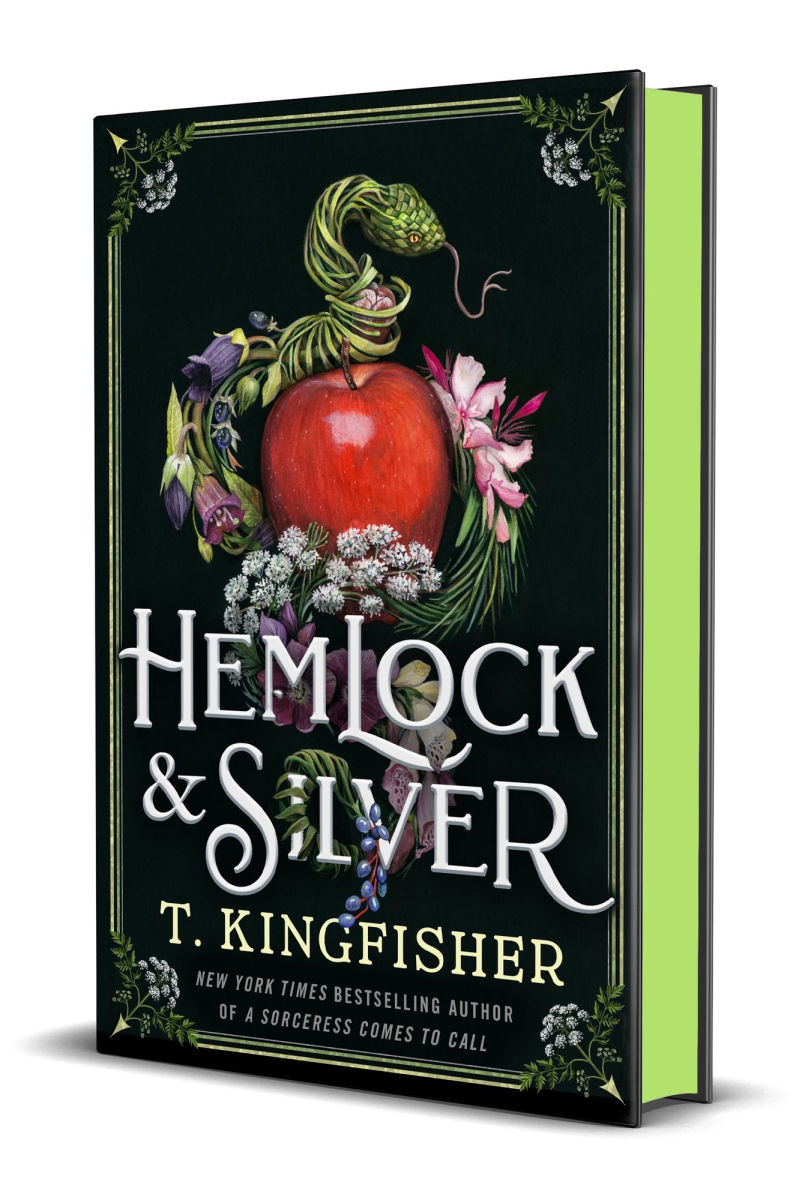
After disliking both The Hollow Places and The Seventh Bride by T. Kingfisher, and for similar reasons (idiot heroine who refused to believe in magic when it was happening right in front of her; annoying tone), I gave up on her works. But since lots of my customers like her, I ordered this book. And when it arrived, it was so beautiful that I had to pick it up and examine it. And then I figured I'd read a couple pages, just to get an idea of what it was about. Those couple pages quickly turned into the first chapter. Then the second. The next thing I knew, I was actually enjoying the book, and finished it with great pleasure.
Anja is a scientist specializing in poisons and antidotes, who regularly takes small doses of poison to understand their effects and test out antidotes. She saves the lives of poisoned people, sometimes. This gets her enough fame that one day the king shows up, asking her to save his daughter, Snow, who he believes is being poisoned...
This is a very loose retelling of "Snow White," making clever use of elements like the apple, the mirror, and the poison.
Like the other books of hers I read, this one is set in an unambiguously magical world and/or has a portal to an unambiguously magical world, and has a heroine who doesn't believe in magic. I guess this is an obligatory Kingfisher thing? At least in this one, Anja doesn't deny that things are happening when they're clearly happening, she just thinks that maybe there is some underlying scientific explanation. This makes at least some sense, as she's a scientist. (Though in my opinion, science is basically a framework and a worldview, and a scientist in a magical world would be doing experiments to figure out how magic works, not denying its existence.) In any case, Anja does not act like an idiot or a flat earther, but pursues the clues she finds and doesn't deny what they suggest. She's kind of monomaniacal, but in a fun way.
Hemlock & Silver meshes multiple genres. It's not a horror novel or even particularly dark for a fantasy, but it has some genuinely scary moments. It's often very funny. And one aspect of the story, while technically fantasy, is so methodically worked out and involves so much science (optics) that it feels like science fiction. There's also a murder mystery, a romance, a surprisingly agreeable rooster, and a talking cat. It all works together quite nicely.
From:
no subject
From:
no subject
From:
no subject
The magic mostly takes the form of "wonderworkers" who each have a highly specific and idiosyncratic magical gift, but there are also leftover pieces of magitech ("wonder engines") from a lost ancient civilization that nobody really understands. Some people study those.
From:
no subject
From:
no subject
From:
no subject
From:
no subject
From:
no subject
From:
no subject
From:
no subject
I liked this book more than I liked her last several. In fact, I liked the hell out of it, but then started coming up with nitpicks the second I finished. Like, after all this interesting worldbuilding, why are sandwiches the default food?
I have a lot of patience for the White Rat setting, especially the Saint of Steel subseries. They do tend to be utterly predictable as far as the romance plots go, though. But the paladins of the Saint of Steel are my people. I identify with them more than is sensible, given my actual existence. (But then, I identified with Sha Gojyo too.)
She does tend to come up with some new intellectual fascinations, then hang her usual characters and plots on them. She almost admits this in a lot of her author's notes at the ends of her books.