![[personal profile]](https://www.dreamwidth.org/img/silk/identity/user.png)
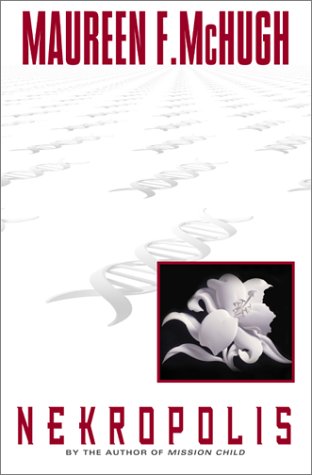
In a future Morocco, a young woman named Hariba with no prospects has herself jessed, a process which renders her loyal to whoever buys her, and sells herself as an indentured servant to a wealthy household. There she meets Akhmim, a harni - a genetically engineered human designed to be a perfect lover or companion. Hariba falls in love with him and runs away with him, but because she's jessed, she becomes extremely sick due to defying her loyalty implant.
Up until this point, the book had a compelling atmosphere a bit reminiscent of The Handmaid's Tale in that it explored the daily life of people living with very little agency in the home of someone who owns them. But once Hariba gets sick, she becomes completely sidelined from the story and basically lies in bed suffering for the entire middle part of the book, while the POV switches from Hariba and Akhmim to first her mother, then her friend - neither of whom are very interesting.
In a moment which doesn't get anywhere near the narrative space or weight it needs, Hariba decides to flee Morocco for Spain, where both jessing and slavery are illegal, and where both she and Akhmim are eligible for asylum. The POV switches back to Hariba and Akhmim when they get there, and my interest immediately picked up. At this point, the ethical issues in Hariba and Akhmim's relationship come into focus, as they're both assigned therapists who point out that he can't consent to a relationship with her as he's engineered to be the perfect lover/companion of whoever claims him. Reluctantly, they agree that this is true and break up.
Akhmim moves in with other harni. He seems basically okay with this, but he also seemed basically okay with Hariba. Hariba is depressed and alienated, and the book ends with her feeling just as unhappy and trapped in Spain as she was in Morocco.
I'd have liked for Hariba and Akhmim to realize the issues with their relationship at least partly of their own accord, rather than them both being told what the issues were and then sadly acquiescing. It also doesn't get into whether or how Akhmim can ever have a sexual or romantic relationship with anyone, if all his relationships are inherently non-consensual, or if harni-harni relationships can avoid that problem. I'm not sure if this was something that was intentionally suggested, as the book is so tightly in Hariba and Akhmim's POVs at this point, but I did wonder if the therapists were also damaging his agency by pushing him and Hariba to end their relationship when he doesn't seem to have the ability to push back - that is, was the social order in Spain also not respecting the harnis's agency, just in a different and subtler way from Morocco?
The theme of the book seems to be helplessness and how attempts to gain agency either don't work or don't bring happiness. Hariba's first big act of agency - running away with Akhmim - removes her from her own life for a long period, and her second results in her losing her last remaining important relationship and switching one miserable life for a different miserable life.
This is a well-written book with interesting issues that sags a lot in the middle portion when Hariba basically drops out of the story, and ends in a note of depression and gloom.
Though I didn't love this book, I'm sorry that McHugh doesn't seem to be writing novels anymore as I did quite like China Mountain Zhang and Mission Child.