![[personal profile]](https://www.dreamwidth.org/img/silk/identity/user.png)
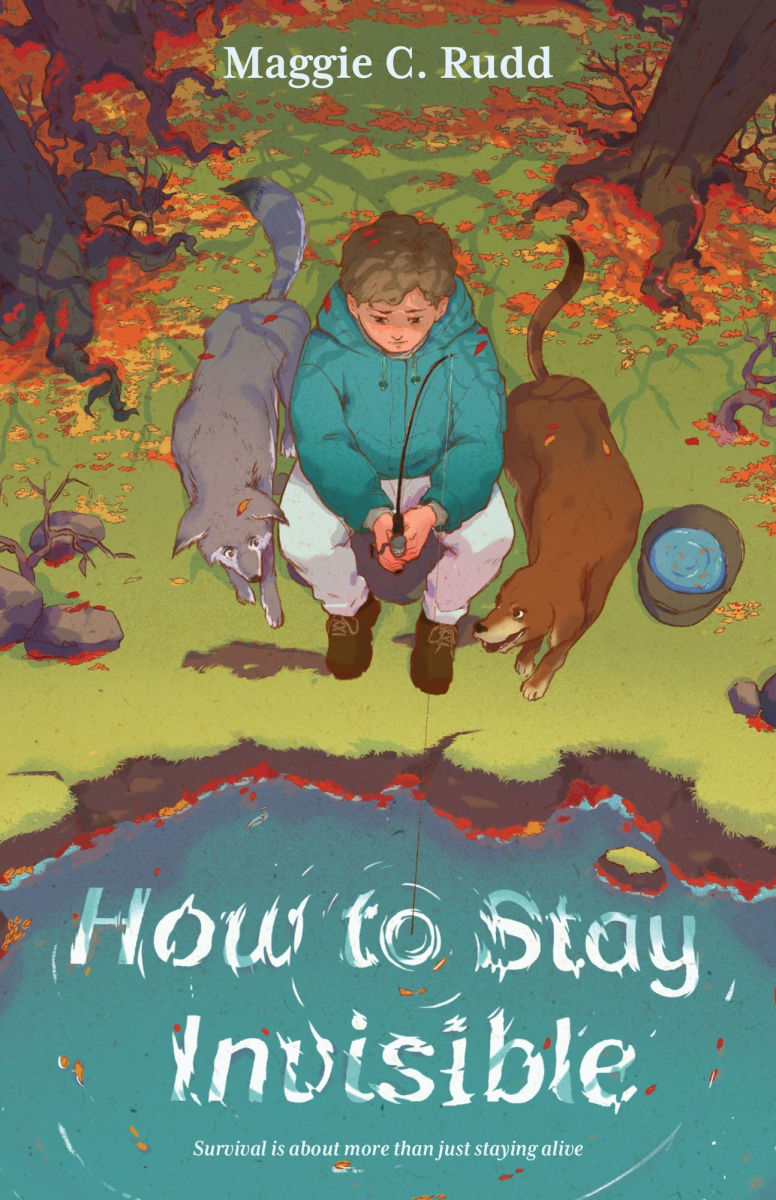
A middle-grade novel about a boy who lives in the woods, tagged as "A worthy successor to Hatchet and My Side of the Mountain."
12-year-old Raymond Hurley lives with his beloved dog Rosie and his neglectful, drug addict, emotionally abusive parents, who move constantly, have only cooked a homemade meal for him once in his entire life, and scream at him and stomp out when he cooks Thanksgiving for them. The one time he told anyone about this, he was temporarily placed in a children's home that was even worse than living with his parents, so he has decided to never tell anyone anything ever.
When they take off, ditching him and Rosie, he lives in the woods behind his middle-school. He continues attending school, as they feed him twice a day. Otherwise, he dumpster-dives after hours at the school, and fishes in the river. While this is all going on, he accidentally makes two friends at school despite his resolve to stay under the radar, accidentally befriends an old man who also fishes in the river, and accidentally tames a coyote (!), who he names Hank. But obviously, this is all unsustainable long-term...
This book isn't that much like the classic "kid survives in woods" books. It's not really about wilderness survival, it's about homelessness and the psychological effects of negligence. It doesn't have the vibe at all of something like Hatchet, where there's something satisfying and profound about living off the land and being in nature, even though it's hard and dangerous and uncomfortable. Raymond's life in the woods is just sad. It's closer to something like Homecoming, in which four kids abandoned by their mother make their way across the country in search of a home, but it's sadder and more aimless than that because Raymond is alone in his predicament and doesn't have a goal other than "stay out of the children's home."
The elements that are survival-y, like taming the coyote, clash with the overall feel of suburban social issue fiction. Especially because they're wildly unrealistic - you can't tame a coyote to the point of petting it and playing with it and having it play with your dog! A coyote will EAT your dog! (There's a key scene involving a venomous snake that also pinged my "it doesn't work that way" sense.)
I didn't really like this book, though it's not a bad book at all. I would have liked it better if it had fully committed to being a realistic book about a homeless child. I also would have liked it better if Raymond's big goal wasn't just "stay out of the children's home," but "stay out of the children's home because I hate it and they'll take away Rosie and who knows what will happen to her." He never once worries about that, which seems like a really odd thing to not be concerned about under the circumstances. If he'd been committed to protecting Rosie, it would have given him and the book more drive. I get that the writer wanted to have Raymond be more just drifting through life, but since he's putting a lot of effort into not getting caught, I think it would have made the book more compelling if the effort was connected to a living being he cared about.
The ending is an absolutely typical ending for this sort of book:
"Everything sucks but there's a tiny ray of hope."
Raymond is bitten by a poisonous snake and instantly passes out and is on the verge of death. But the old man he befriended finds him in the nick of time, being guarded by his faithful tame coyote. The cops shoot the coyote and take Raymond to the hospital.
Though the old man offers to foster Raymond, so he can live with someone he already knows and loves and stay in the school where he has friends, the social workers won't allow it and place him in another town with foster parents. But he does get to keep his dog. Yes! The coyote dies but the dog survives!
Content notes: child abuse, homelessness, animal death.
From:
no subject
Regardless of the realism of the coyote-taming, that's incredibly upsetting.
From:
no subject
From:
no subject
An example of doing it right!
https://www.abc.net.au/news/2025-12-30/bushwalker-survives-brown-snake-bite-morton-national-park-venom/106184490
From:
no subject
From:
no subject
From:
no subject
From:
no subject
From:
no subject
Seems excessive.
From:
no subject
From:
no subject
From:
no subject
From:
no subject
From:
no subject
From:
no subject
From:
no subject
Also: They shoot the coyote? Geez, of course they do.
From:
no subject
Anyway. Sounds sad and not for me.
From:
no subject
From:
no subject
From:
no subject
From:
no subject
Which book was that?
From:
no subject
From:
no subject
So, back in the 7th grade (6th grade? IDK) we read The Giver, and when our teacher asked what we thought the ending meant I said that he went down a hill on a sled and she did not appreciate my answer. That woman had no sense of humor.
Years later, Lois Lowry writes Messenger and Son, and in those books it's explicitly confirmed that he literally went down a hill on a sled and he and Gabe both survived and are just fine a decade later, and on the one hand those books are super Jesusy and not so great but on the other hand every time I think about them I want to buy a boxed set, look up my old teacher, and mail her a copy.
(I don't remember which grade this was, but I do remember it was the teacher who publicly berated me for my poor handwriting and said she wouldn't accept anything more from me until I started writing in cursive, and so I didn't hand in any spelling tests or anything else for three weeks. She never said anything once I did start handing them in again, and looking back she was so far out of line - I mean, she must've known I wasn't in control of my handwriting, it was extremely obviously not something I could do better - that she must've been relieved I hadn't told my mother, because that conversation would not have gone well for her at all.)
From:
no subject
I did not realize she had written sequels. Googling says she originally enjoyed the ambiguity, but later wanted to explore something...something and so they survived. Glad to know I wasn't so crazy for taking it literally.
I'm also reminded of the movie Henry Fool, which I loved. A friend asked me about the ending, where a character can be seen to be doing X, but the objective could be one of two possibilities. The other possibility hadn't even occurred to me. Apparently someone watched a cut of the movie, and asked the writer-director, it's objective A, right? Which was the opposite of what the director had in mind. He decided he liked the ambiguity and recut it to enhance the uncertainty. Then, years later, put out a sequel that made it unambiguous. I still haven't seen the sequel.
(I'm also reminded of The Giving Tree, which I read after seeing a discussion that it could be read as a horror story of how women do all the emotional heavy lifting. Yup, on reading it, I totally saw that reading. I guess it's coincidental that "Giver" and "Giving" are related words.)
From:
no subject
From:
no subject
Have you read "Sal" by Mick Kitson? It's not children's literature but it has elements of "The Hatchet" (I remember a lot about his book even though I must have read it over 20 years ago) but it also deals with child abuse and there is a friendly older stranger the kids befriend.
From:
no subject
I haven't yet read Sal but I do own it.
From:
no subject
A. Parents do have a right to say they want the kid to stay with a friend and
B. There are always exceptions if they can be made. Rules are, after all, only as strong as the people who enforce them and
C. If all else fails, social services can quietly call the situation resolved and back out. If the living situation is resolved, there’s no reason for child services to care or to pay out a stipend.
From:
no subject
There are some rules you have to follow to become a foster parent but I don't think that a background check would take six months. There might be seminars one has to take but I'm not sure how often those are offered.